

Lotus: a defined drill target.
Why Lotus?
Drilling is designed to test the continuity, geometry and grade of a known mineralised system beneath the historic workings.
Historic producer with gold-bearing quartz veins exposed at surface.
Visible gold confirmed; high-grade modern grab samples to 489 g/t.
Esso brought Lotus into production in 1982 as supplementary San Antonio mill feed — 8,287 t milled at 4.56 g/t.
Down-plunge and down-dip extensions below the historic workings remain untested.
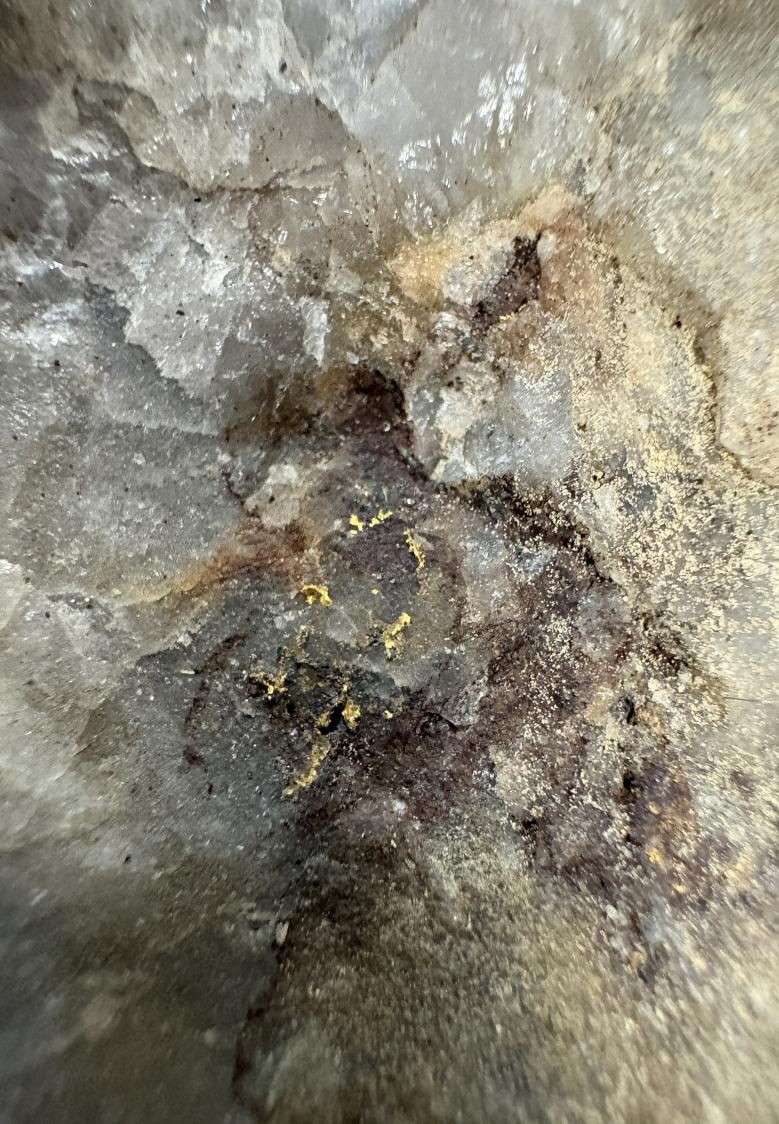
Grab samples up to 489 g/t Au at Lotus.
Peak grab sample — Lotus
489 g/t
59 grab samples, Lotus & Betty, 0.008–489 g/t Au.
35 > 1 g/t · 23 > 5 g/t · 3 > 100 g/t.
Visible gold in 12 Lotus samples. Betty: to 27.2 g/t, polymetallic (tetrahedrite–chalcopyrite).
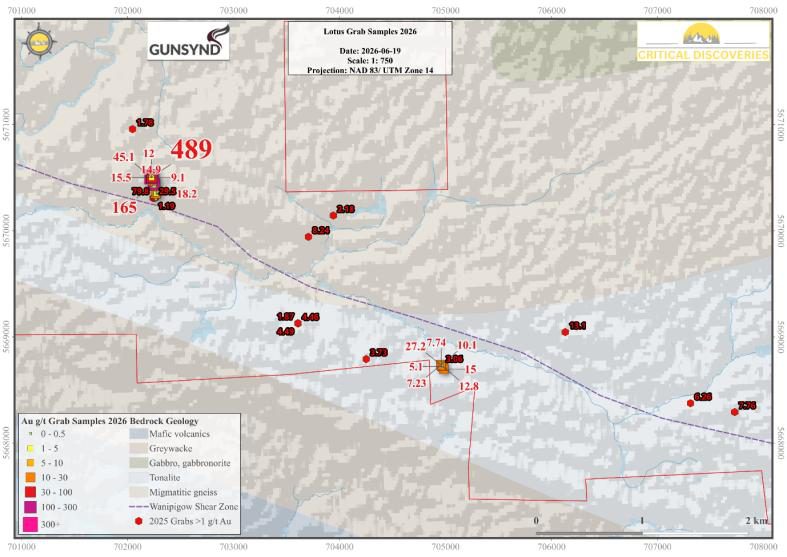
Lotus grab samples 2026. Projection NAD 83 / UTM Zone 14.
Fist-sized grab samples from sites of observed mineralisation — selective and not representative of in-situ grade, width or continuity. Fire assay / gravimetric (Actlabs cert. A26-09795). Multi-element results returned.
Historic production & grades — Lotus
1982 production: 8,287 t milled at 4.56 g/t (~1,200 oz). ER86-1 (Richardson & Ostry) & Misc 94-6; via MB Mineral Policy survey.
34.29 g/t — Ling shaft channel sample, 1.5 m. Manitoba Mineral Inventory File 375.
22.49 g/t — 1930 bulk shipment. Parsons, A.L. (1932), federal Mines Branch.
Four gold-bearing shoots · visible gold documented. Hall, R.S. (1980), Esso assessment file AF92914.
22 holes drilled, 3,850 ft (1980). Hall, R.S. (1980), Esso assessment file AF92914, Table 1.
Historical figures pre-date NI 43-101 / JORC reporting standards and have not been verified by a Qualified Person. Historic grab and channel samples are selective and not representative of in-situ grade, width or continuity.